Red Lobsters are Dead Lobsters

I recently submitted a first draft of an essay on Victorian women nonsense poets. Writing it a challenge because, as it turns out, there aren’t many. I asked around in the hopes of crowd-sourcing, and most of my Victorianist friends would name Christina Rossetti’s Sing-Song: A Nursery Rhyme Book and then grow quiet, staring thoughtfully into the middle distance.

I would sometimes join them, but it turns out there are not any Victorian women nonsense poets residing in the middle distance. I did, however, appreciate revisiting Sing-Song. While most making the case that it’s nonsense refer to the verse that begins “If a pig wore a wig,” I prefer this one:

Thank you, Arthur Hughes, for illustrating a lizard using its tail as a sassy scarf.

One of my oddest finds during this particular research project was Blue and Red, or, The Discontented Lobster, a long comic poem of the “grass-is-always-greener” variety that was published first in Aunt Judy’s Magazine in 1881 and two years later by the Society for the Promotion of Christian Knowledge as a toy book illustrated by Richard André. The titular lobster, who possesses an admirable blue shell and a sulky attitude, is caught and displayed in an aquarium, where he observes the vivid vermillion shells of a different species. He longs to be red, and his wish is granted when he is discovered by a chef. As the narrator laments,

It seems to me a mean end to a ballad,
But the truth is, he was made into a salad;
It’s not how one’s hero should end his days,
In a mayonnaise.

I’ve been a Ewing fan for some time, but this is the first time I’d encountered André, whose illustrations are a little uneven but occasionally really delightful. One of my favorites depicts the lobster’s view of passerby — an image that situates the reader behind the lobster, suggesting the claustrophobic (to me) or delightful (to the lobster) status of the looked-at.
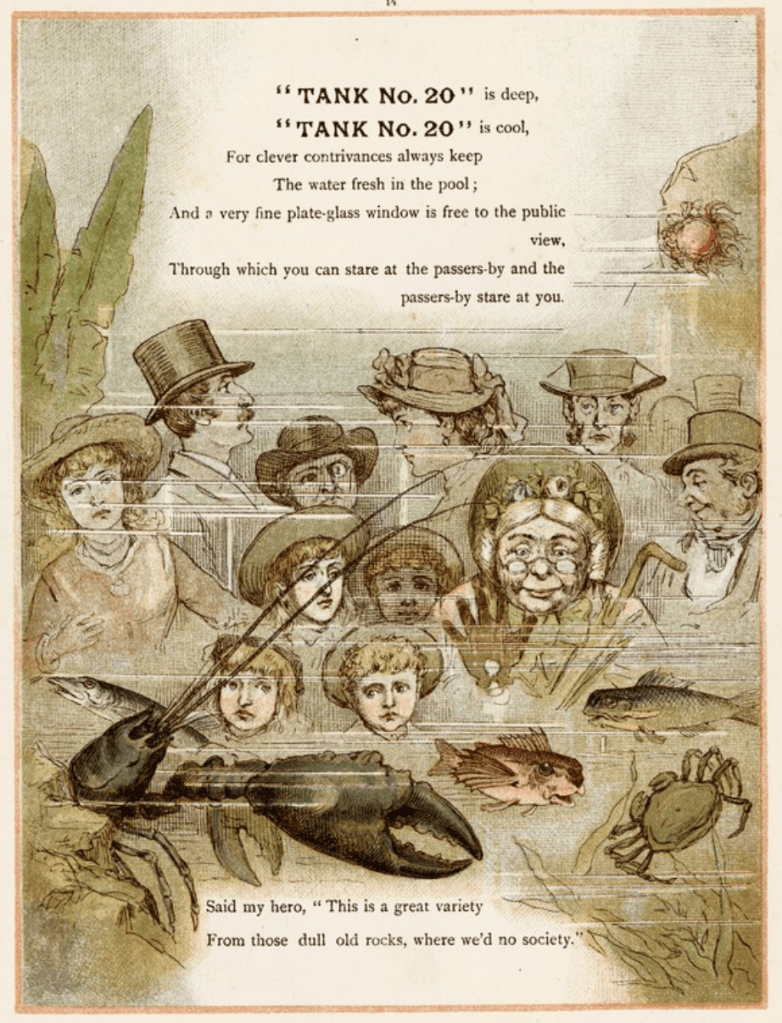
And then there is André’s depiction of the lobster’s moment of greatest discontent, in which he stares longingly at his future undoing, the reader powerless to explain the grim reality of a red shell:

Kids Don’t Wait for No Ghosts

Every once in awhile I abandon methodical research and do some desultory internet browsing related to a research project, just to see what Uncle Google has to offer. I find a rabbit-hole and fall through, clicking links in a sort of inattentive, lazy way. I was, in fact, rabbit-holing just last week, trying to find a new angle on my exploration of Spiritualism and childhood.

I found this article from the Chicago Tribune, dated 1 November 1909:

SPEECHES BY LITTLE FOLKS. Perfection. Speeches by little folks are definitely my jam.

And after spending a few weeks eyeballs-deep in Spiritualist periodicals, searching for the children’s columns in newspapers with titles like Carrier Dove and Banner of Light, it was refreshing to read an article that certainly did not take the mediumistic powers of young people seriously. While (according to this Tribune writer) each young person participating in this “children’s meeting” was instructed to delay speaking until prompted to do sp by a “control,” or spirit, most did not have such patience and instead began immediately.

It really feels like an old-timey marshmallow test, and these child mediums can’t help themselves. They are ready to testify, and they don’t need to wait for some spooky voice from beyond.

But what I really appreciate about a find like this, aside from the fact that it clued me in that such meetings of child Spiritualists took place — to the library! — is that it offers me the first of what will likely become many counterpoints to all those sources I’ve already found that take child mediumship very, very seriously. I’m not particularly interested in making child mediums ridiculous, something this writer obviously delights in doing. (Later in the article, the writer notes that the children’s “hurried efforts to get rid of their orations reminded some of the elders present of the ‘last day of school’ programs they had seen in the primary grades.”) But now that I have in place two contradictory takes on child mediums in place — reverent and ridiculous — I can start filling the nuanced space between.

Editing… FROM THE GRAVE

I’ve been spending a lot of time in the archives of the International Association for the Preservation of Spiritualist and Occult Periodicals. Besides just being a generally good time, these periodicals likely are going to be important primary sources in my next book, How Children See: Vision and Childhood Around 1900, which will include a chapter on child mediums.

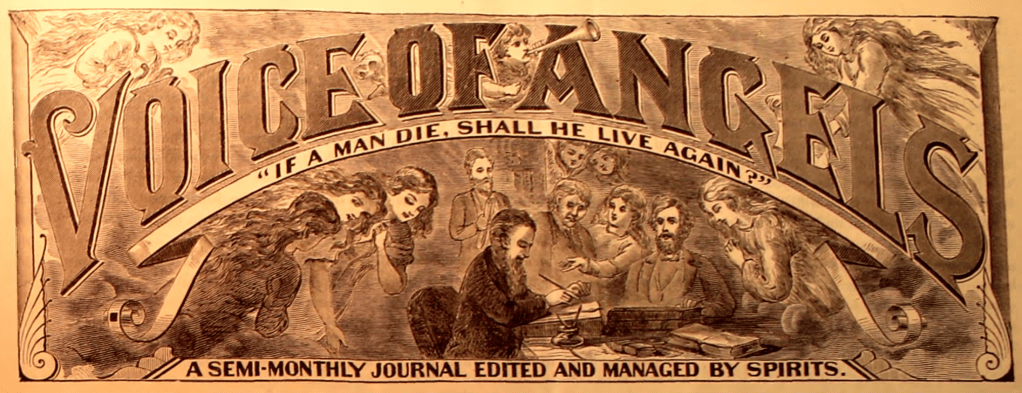
Today I was looking in particular at Voice of Angels, a nineteenth-century periodical based in Massachusetts purportedly edited and managed by spirits (though mediums).

Masthead from the Spiritualist periodical Voice of Angels, picturing the a man writing surrounded by ghostly figures

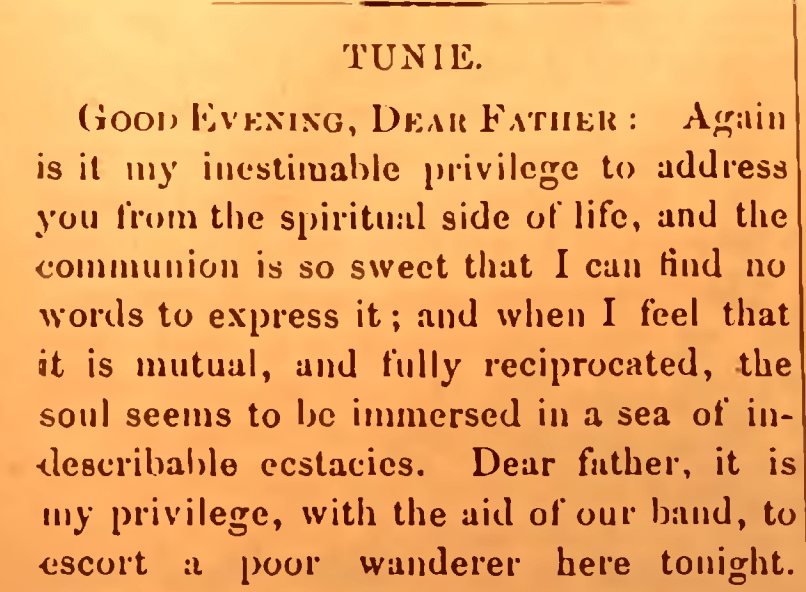
I am particularly interested in Voice of Angels because it regularly features Tunie, the “angel daughter” of the editor, David C. Densmore. Tunie sometimes acts as a sort of liaison between the spirit world and her father (and the readers of the newspaper). For example, in the issue published on 1 February 1878 (vol. 3, no. 3), Tunie attempts to help a spirit who is not adjusting to the spirit world. Here’s the beginning of that column:

Tunie isn’t the only spirit child who acted as a regular contributor to a nineteenth-century Spiritualist periodical, and in the coming months I’ll be thinking about how these “angel children” both reinforce and transform Romantic notions of childhood.

Although he has so soft a face…

Recently, impatient about my inability to travel to archives, I sought out and purchased a not-too-expensive first edition of Lord Alfred Douglas’s first book of nonsense, Tails with a Twist. I’m writing an article about Douglas’s nonsense, and I really wanted to see the original illustrations by Punch political cartoonist E. T. Reed. (My reprint edition includes illustrations that are not NEARLY as good.)

My opening gambit in what I affectionally call The Dougie Article relies on a brief reading of “The Antelope” from Tails with a Twist, so I was hoping that this particular poem would be illustrated — but alas, it is not. I was, however, absolutely delighted with Reed’s depiction of “The Rabbit”:

The poem itself is one of my favorites. It begins: “The Rabbit has an evil mind, / Although he looks so good and kind. / His life is a complete disgrace, / Although he has so soft a face.”

And Reed’s illustration makes me love the poem even more. I particularly appreciate the way the composition of the image chimes with John Tenniel’s illustration of the trial over the tarts from Lewis Carroll’s Alice’s Adventures in Wonderland:

Douglas was a fan of Carroll’s nonsense, so the similarity is likely not coincidental. In my article, I explore not only the relationship between Douglas’s nonsense and the Victorian tradition of nonsense for children but also the ways Douglas acknowledges, and critiques, discourses about same-sex desire prevalent in fin-de-siècle writings in degeneration and sexology. I hope that I’ll soon be able to share where this article lands!