Funny Women

You know how some jerks like to say that women aren’t funny? It turns out that falsehood has been around for some time — perpetuated, for example, by many nineteenth-century reviewers and anthologists. Alfred H. Miles wrote in 1897 that it is a “contention often made that women are distinctly lacking in a sense of humour” (613). (Spoiler alert: he agreed.) And when reviewers wrote of nonsense poet May Kendall, they noted her “rare gift of humour—a quality not always present in the gentler sex” (“Recent” 27).

So yeah. Jerks.

I write about May Kendall and other witty Victorian female poets — especially Christina Rossetti and Juliana Horatia Ewing — in one my of latest publications: an entry on nonsense poetry The Palgrave Encyclopedia of Victorian Women’s Writing. One of my favorite things about this short piece? It let me think about the intersections of nineteenth-century science and poetry, including this amazing piece published in Punch in 1888:

Palgrave Encyclopedia of Victorian Women’s Writing is edited by Lisa Scholl and Emily Morris. It is available online (and soon in print, as well). Contact me if you don’t have access and would like to read my entry!

Works Cited

Miles, Alfred H. The Poets and Poetry of the Century, Vol. 9: Humour, Society, Parody, and Occasional Verse. Hutchinston, 1894.

“Recent Poetry and Verse.” Graphic, issue 947, 21 January 1888, p. 27.

Talking about Nasty, Biting Things

I am delighted to be part of the 2020–2021 speaker series hosted by the Center for Children’s Books at the University of Illinois at Urbana-Champaign! On October 8, at 1:00 pm EST, I will give a talk via Zoom titled “A Nasty, Biting, Thing: The Wayward Child as Collaborator.” The talk will look backward to some of the adult-child collaborations I explored in Between Generations and forward to my next project on children and vision.

title page to Animal Land Where There Are No People, a collaboration between four-year-old Sybil Corbet and her mother Katharine Corbet, which I’ll discuss on Oct. 8

In particular, I’ll focus on three intergenerational collaborations forged over art: the “Nursery Nonsense” feature in the popular Aunt Judy’s Magazine, which invited young artists to illustrate (and undermine) stories narrated by their parents; the 1897 nonsense bestiary Animal Land Where There Are No People, a collection of grotesque creatures created by four-year-old Sybil Corbet and recorded by her mother, Katharine (see above); and Flora, a 1919 collection of sometimes-subversive drawings by child artist Pamela Bianco, accompanied by poems by Walter de la Mare. All three illuminate shifting ideas of childhood and creativity circulating at the end of the nineteenth and beginning of the twentieth century. More importantly, they challenge how we as scholars typically approach the place of the child in cultural production and children’s ability to acknowledge, and negotiate, those roles.

I look forward to sharing this work and will share the Zoom link when it’s available. I encourage you to check out the other speakers who are participating in this exciting series:

Launch of Children’s Literature and Culture Resource

I was happy to serve on the editorial board of the Children’s Literature and Culture project, which digitized an amazing array of materials — including books, games, toys, photographs, music, and other graphic material — from the American Antiquarian Society‘s Children’s Literature and Graphic Arts collections. I’m happy to announce that the project just launched!

some beautiful work by Walter Crane on the project’s homepage

You can read a blog post by senior editor Steve Edwards about the project’s launch and some of the materials related to Christmas contained in the collection here.

Second edition of Keywords for Children’s Literature

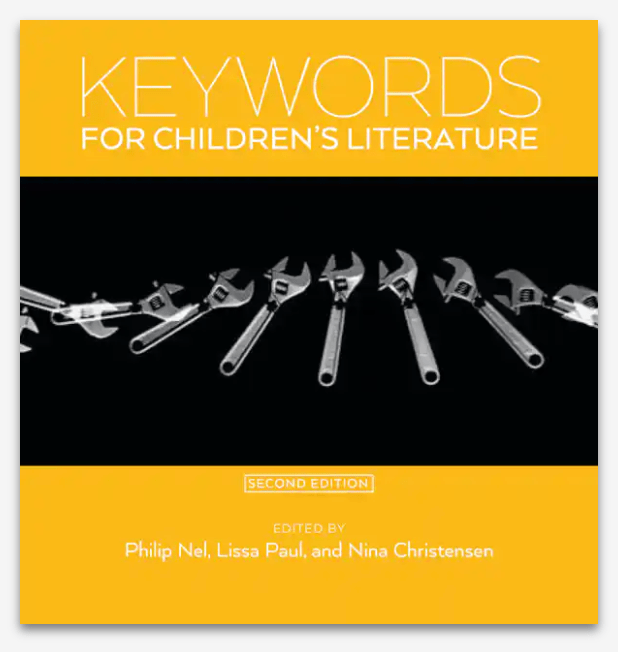
The second edition of Keywords for Children’s Literature is now available for pre-order on New York University Press’s website. This new edition includes dozens of essays on terms vital to the study of children’s literature and includes scholars from around the world.


I am happy to be included in this collection as the author of the entry on “adult,” and I am grateful for the dedication and hard work of the collection’s editors: Philip Nel, Lissa Paul, and Nina Christensen.

Changing roles in ChLA

I’m happy to announce that I have just begun a three-year term on the Board of Directors of the Children’s Literature Association. I’m looking forward to working with a talented group of scholars and educators to make our association even more vibrant and to work toward greater diversity and equity.

I have also completed my term as the chair of ChLa’s Article Award Committee. I have served on this committee as both member and chair since 2014, and I’ve appreciated the opportunity to read (and prize!) some of the best scholarship in my field. I’m passing the committee to the capable hands of KaaVonia Hinton.